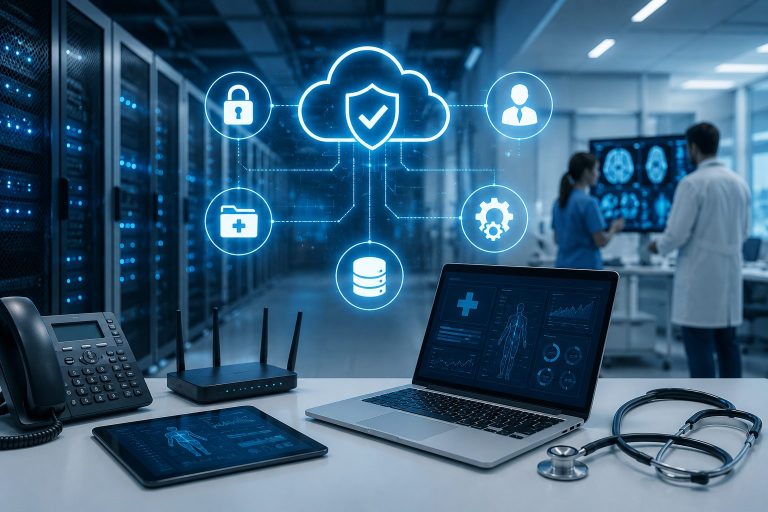


Healthcare today feels like a constant balancing act. Doctors focus on patients. Admin teams juggle records. IT teams fight silent battles behind the scenes. And somewhere in between, systems must always stay up.
Because in healthcare, downtime isn’t just inconvenient—it can be risky. That’s why reliable technology and IT infrastructure are no longer optional.
The Real Cost of System Downtime
Imagine a busy hospital morning. The waiting area is packed. Nurses move quickly between rooms. A doctor opens a patient’s digital record — and the system freezes. Just five minutes of downtime. Seems minor. But now the lab reports are delayed. Billing queues grow longer. Patients become restless. Staff stress rises.
Small disruptions quickly turn into operational chaos.
Healthcare environments run on interconnected platforms — Electronic Health Records, appointment systems, diagnostic tools, insurance portals. If one system slows down, the ripple effect spreads everywhere.
Managing Growing IT Complexity
Healthcare technology has evolved rapidly. Hospitals now use cloud platforms, mobile apps, remote monitoring tools, and telemedicine systems. These innovations improve patient care, but they also increase system complexity.
Managing multiple integrations requires strong infrastructure planning. Without it, performance issues and unexpected outages become common. That’s why healthcare organizations are shifting towards smarter IT frameworks designed for stability and scalability.
Predictive Monitoring: Fixing Problems Before They Start
Modern IT solutions focus on prevention rather than reaction. Predictive monitoring tools track server health, network traffic, storage usage, and software performance in real time. They alert IT teams before systems crash.
It works like routine health check-ups — identifying risks early helps avoid emergencies later.
This proactive approach reduces downtime, improves workflow continuity, and ensures smoother patient experiences.
Cloud Adoption for Business Continuity
Traditional on-premise servers can fail due to hardware issues, power disruptions, or maintenance delays. Cloud-based healthcare systems provide built-in backup and remote accessibility.
Even if local infrastructure faces problems, operations can continue from alternative locations. Doctors can access patient data securely. Administrative work stays on track. Patients receive uninterrupted care.
Cybersecurity: Protecting Data and Trust
Healthcare institutions handle extremely sensitive information. Cyberattacks such as ransomware can bring entire systems to a halt. Strong IT solutions include data encryption, multi-layer authentication, regular security audits, and real-time threat detection.
These safeguards protect not just digital assets — but also patient confidence.
The Human Side of Technology
Technology works best when people understand how to use it. Many downtime incidents occur due to simple mistakes, outdated processes, skipped updates, or lack of training.
Regular staff training builds confidence and reduces operational errors. Teams feel more comfortable using digital systems, leading to smoother daily workflows.
Interestingly, this idea of technology working quietly in the background reminds me of a hypothetical first-time experience.
Building Resilient Healthcare IT Systems
As healthcare operations grow more complex, the need for dependable IT support becomes critical. Strategic infrastructure planning, predictive monitoring, cloud integration, cybersecurity readiness, and staff training all contribute to minimizing downtime.
Companies like Harjai Technologies help healthcare providers create stable, future-ready IT environments that support uninterrupted patient care and operational efficiency.